|
|
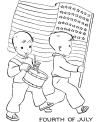
What does the American flag stand for?
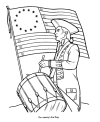
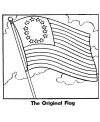
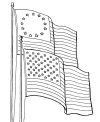
On June 14, 1777, Congress approved the first national American flag. Since that time June 14 has been known as Flag Day. Americans are urged to display the flag on that day each year.
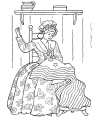
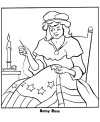
It is said that Betsy Ross made the first American flag, stitching it carefully by hand. The colors represent red for valor, white for purity and blue for justice. The thirteen stripes represent the thirteen original colonies. The first flag had thirteen stars. The number of stars has been changed many times. In 1960 the American flag added its fiftieth star. The number of stars remains the same.
|

|
"Coloring Pages" |

|
 |
|
American Flag History - The Star-Spangled Banner
In August of 1814, British soldiers marched on Washington and burned the White House and Capitol. On September 12, the British fleet of ships in the Chesapeake Bay moved toward Fort McHenry, which guarded the Baltimore harbor. On the night of the 13th they began shelling the fort in a battle that lasted into the next day.
Before the shelling started, a Washington lawyer by the name of Francis Scott Key, sailed out to the British fleet under a flag of truce to arrange for the release of a prisoner. While Key was still on board, the British started firing. Throughout the night he watched the American flag over Fort McHenry. When the American flag was still flying the next morning, he knew that the fort had not surrendered. He was so thrilled and overcome with emotion that he immediately wrote a poem which he entitled "The Defense of Fort McHenry"
The poem read: "O, say can you see by the dawn's early light, what so proudly we hail at the twilight's last gleaming?" Almost immediately it was printed on handbills and circulated throughout the nation. Soon it was being sung to an old British tune. About one month later the title of the poem was changed to "The Star-Spangled Banner." The British had lost the fight for Fort McHenry and this battle gave us a patriotic song that was to become our National Anthem.
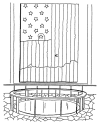
This American flag that inspired Francis Scott Key now hangs in the Museum of History. It is tattered and torn, but still a beautiful sight.
|
About American Flag Coloring Pages:
American Flag coloring pages are fun, but they also help kids develop many important skills. These skills, eye-hand coordination, color concepts, picture comprehension, form the foundation for early learning success. Enjoy these free, printable American Flag coloring pages!
Use of our American Flag Coloring Pages:
Our American Flag coloring pages may be used only for your personal, non-commercial use. Parents, teachers, churches and recognized nonprofit organizations may print or copy multiple coloring pages for use at home or in the classroom.
|
|

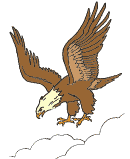
The Bald Eagle
The Bald Eagle is the national bird of the United States. It is one of the country's most recognizable symbols, and appears on most of its official seals, including the Seal of the President of the United States. Coloring pages and more ...
|
|
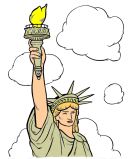
Statue of Liberty
What does the Statue of Liberty represent? ... How tall is the Statue of Liberty and why is the Statue of Liberty green? ... Where is the Statue of Liberty located and what is the Statue of Liberty poem and quote? Answers and more...
Patriotic Fun & Learning
|
|
|